


Ultrasound testing (UT – Ultrasonic Testing) is one of the most commonly used non-destructive testing methods, enabling the detection of internal and subsurface discontinuities in metallic materials. The method involves the introduction of ultrasonic waves into the tested element and analysis of the signals reflected from the material boundaries and any potential defects.
UT allows for precise localization of discrepancies and assessment of their size and location, without the need to destroy the tested element.
Where and when are ultrasonic tests (UT) performed?
UT testing is performed wherever material volume testing is required:
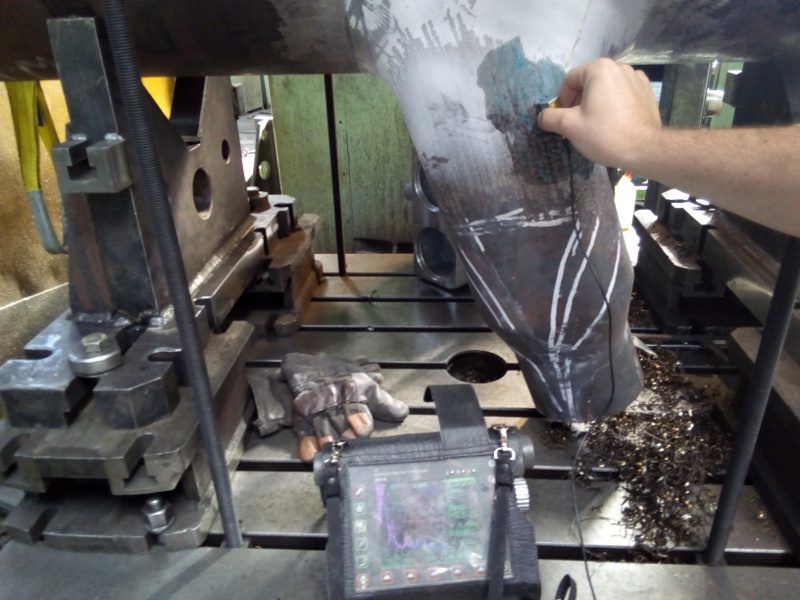
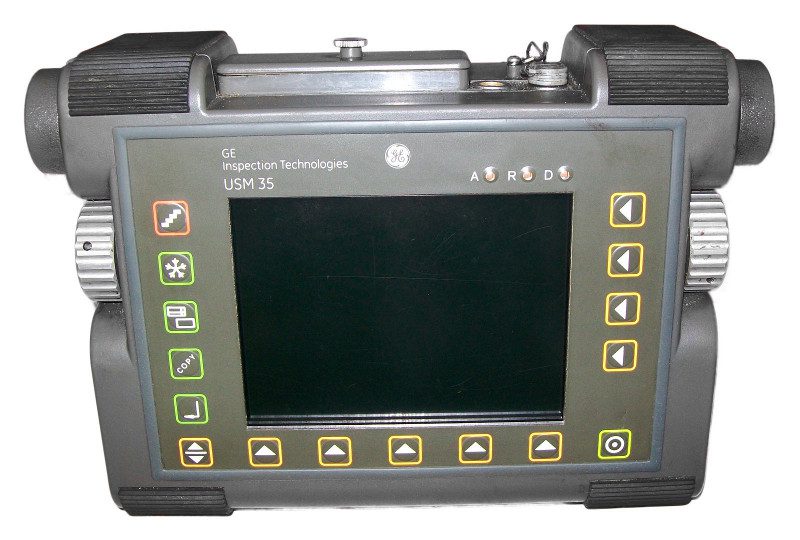
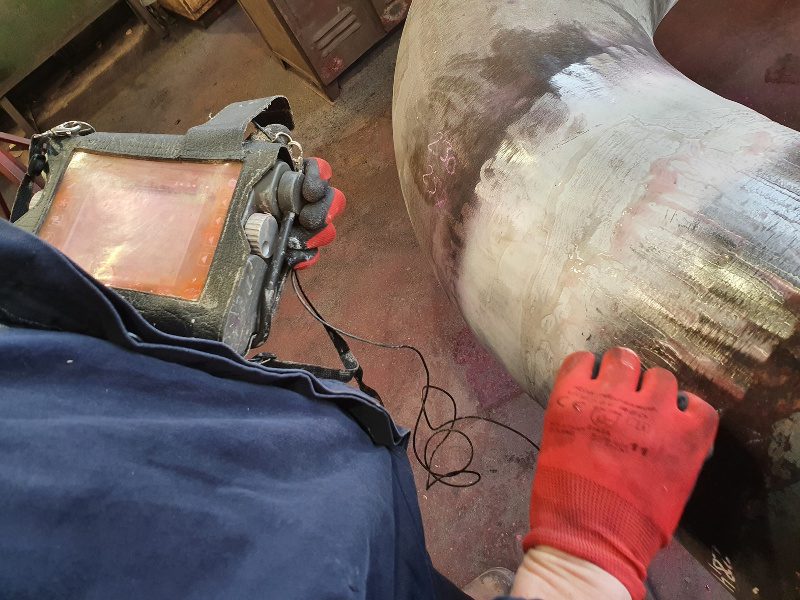

1. Welds

Full penetration welded joints and heat affected zone,
2. Forgings:
detection of delaminations, cracks and forging discontinuities, etc.,
3. Castings:
identification of shrinkage cavities, porosity and cracks,
assessment of the homogeneity of the material structure.
Types and techniques of ultrasonic testing
1. Classical (conventional) UT research
straight heads – for detecting defects perpendicular to the surface,
angle heads – especially useful for examining welds.
2. Complementary techniques
TOFD (Time of Flight Diffraction),
Phased Array (PAUT) – for increased accuracy requirements.
How is an ultrasonic examination (UT) performed?
- Analysis of documentation and scope of the study
Determination of element geometry, material and acceptance criteria. - Surface preparation
Cleaning and ensuring appropriate acoustic coupling. - Calibration of UT equipment
Performing calibration on reference standards. - Scanning the tested item
Moving the head over the surface while observing signals. - Interpretation of results
Analysis of indications and determination of the nature of discontinuities. - Documentation
Preparation of a UT report with the test results.
What can ultrasonic testing (UT) detect?
UT tests enable the detection of, among others:
internal and subsurface cracks,
lack of penetration and sticking in welds,
porosity and shrinkage cavities in castings,
delaminations and forging discontinuities in forgings,
fatigue and operational defects.
UT allows for exact location of the defect in the material (depth, distance, orientation).
Advantages of ultrasonic testing
the ability to test large material thicknesses,
high sensitivity of detecting internal defects,
quick test result,
no radiation,
possibility of field research,
relatively low cost compared to RT.
Ultrasonic testing (UT) standards
Ultrasonic testing is performed in accordance with the following standards:
PN-EN ISO 17640 – Ultrasound Testing – Techniques, Test Levels and Assessment
PN-EN ISO 11666 – Non-destructive testing of welds – Ultrasonic testing – Acceptance levels
PN-EN ISO 10893 -8 – Automatic ultrasonic testing of seamless and welded steel pipes to detect delamination
PN-EN-ISO 10893-10 – Automatic ultrasonic testing of seamless and welded steel pipes (excluding submerged arc welded pipes) to detect longitudinal and/or transverse discontinuities
PN-EN 10228-3 -Ultrasonic testing of ferritic or martensitic steel forgings
PN-EN 12680-2 – Ultrasonic testing – Steel castings for parts operating under high loads